Claims are settled on evidence you gathered beforehand
After a fire, a flood or a break-in, the instrument is gone and so is the chance to document it. Everything the adjuster works from is whatever you recorded in advance. Owners who can hand over an itemised list with serial numbers, receipts and dated values get paid on those values. Owners who can't end up negotiating from memory — and memory loses.
The same record does double duty: it is exactly what an insurer asks for before they will quote or schedule your instruments in the first place. Build it once, use it for both.
What a complete record contains
- Make, model, year and finishThe exact variant — “1998 Gibson Les Paul Standard, honeyburst”, not “Les Paul”.
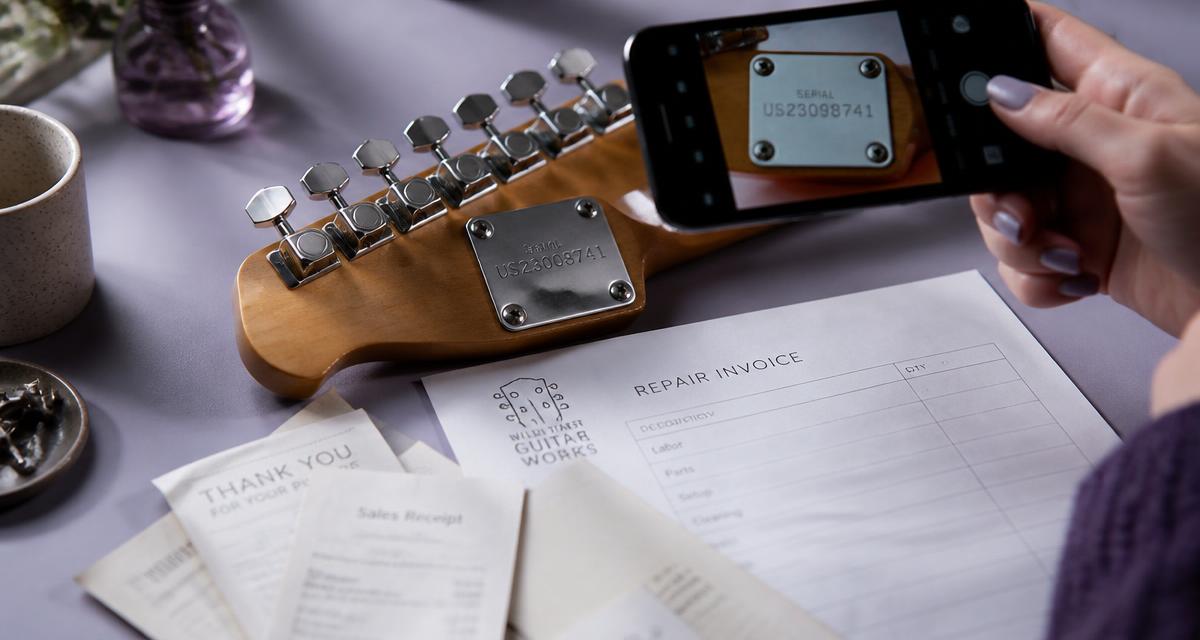
- Serial numberWritten down and photographed close enough to read every character.
- Purchase date, price and receiptThe first thing an adjuster asks for, and the easiest to lose.
- Current market value plus its dateA value with no date behind it is hard to defend at claim time.
- Photos from every angleFront, back, headstock, hardware, electronics cavity, case.
- Existing damage and wearDocumenting a ding now stops it being argued as pre-existing later.
- Non-original partsPickups, tuners, bridges and electronics you paid to upgrade.
- Case, straps and accessoriesOften insurable, and almost always forgotten.
- Service and repair invoicesDated proof of maintenance and of money spent on the instrument.
- Appraisal for vintage piecesRequired by most insurers above their value threshold.
Photographing the serial number, and everything else
The serial number is the single field that ties a specific instrument to you. Police recovery databases, pawn shops and insurers all work from it, so photograph the number itself — close, in focus, every character readable — rather than relying on a wide shot of the headstock. Then work through the rest of the set:
- Full frontWhole instrument, square on, good even light.
- Full backShows finish checking, belt wear and back-plate screws.
- Headstock front and backLogo, tuners, and the serial if it lives there.
- Serial number close-upFilling the frame and readable, not a wide shot.
- Bridge and hardwareBridge, saddles, pickups, knobs and switch tips.
- Electronics cavityOnly if you can open it safely — proves original or upgraded parts.
- Any damage or repairDings, cracks, refinishes and repair work, each on its own.
- Case and accessoriesInterior and exterior, plus anything stored with the instrument.
Daylight, a plain background and no flash beats a studio setup. What matters is that the instrument is identifiable and its condition on the day is visible.
Receipts, invoices and other paperwork worth keeping
- Original purchase receipt or invoice. Even a dealer email confirming model, price and date is better than nothing.
- Repair and setup invoices. Refrets, neck resets, electronics work and professional setups are documented value.
- Parts receipts. Aftermarket pickups, tuners and bridges you fitted yourself only count if you can show what they cost.
- Certificates of authenticity. Custom shop, artist series and limited runs usually ship with paperwork that carries real value.
- Appraisals. Written, dated, and naming the instrument and its serial number.
- Your current policy or schedule. Store it with the inventory so you can see instantly what is covered and for how much.
When you need an appraisal — and how to get one
Receipts and recent comparable sales are normally enough for current production instruments. An appraisal becomes worth the fee when the instrument is vintage, custom-shop, boutique, heavily modified, or valued above whatever threshold your insurer sets for agreed-value cover. To get one:
- Ask a specialist dealer, an experienced luthier, or a certified personal-property appraiser who handles musical instruments.
- Bring the instrument, its case and all paperwork — originality drives the number more than condition does.
- Ask for a written report naming the instrument and serial number, the valuation method, the value, and the date.
- Ask what the insurer will accept: some require an appraisal within a set number of years.
- Store the appraisal with the instrument's record and diarise a refresh before it ages out.
For what all of this changes about your premium, see how much guitar insurance costs. For whether your home policy covers instruments at all, read does homeowners insurance cover musical instruments?
The annual review that keeps the record worth having
A record built once and never touched drifts out of date, and most policies pay the documented value. Put a yearly reminder in the calendar and work through four checks:
- Re-check each instrument's value against recent comparable sales.
- Add anything bought since, and remove anything sold — with the sale price logged.
- Add new photos for any damage, repair or modification.
- Compare the new total to your insured amount and tell your insurer if the gap has opened up.
Do the same after any single event that changes value: a purchase, a sale, a refret, a refinish, or a parts swap.
One more use for the same record: it's exactly what your family would need if they ever had to handle the collection without you. See how to leave your heirs a clear record of your collection's value.
Frequently asked questions
How do I get a guitar appraised for insurance?
For current production instruments, recent comparable sales plus your receipt are usually accepted as proof of value. For vintage, custom-shop, boutique or heavily modified instruments, ask a specialist dealer, luthier or a certified personal-property appraiser experienced with musical instruments for a written appraisal that states the instrument, its serial number, the valuation method and the date. Most insurers want an appraisal no more than a few years old.
What should a guitar insurance record contain?
Make, model, year and finish; serial number with a close-up photo; purchase date, price and receipt; current market value with the date it was checked; photographs from every angle including damage and modifications; non-original parts; case and accessories; and dated repair or setup records.
Do I need photos of the serial number?
Yes. The serial number is what ties a recovered or claimed instrument to you specifically. Photograph the number itself close enough to read, and keep it with the rest of the record rather than only on the phone that might be stolen alongside the guitar.
How often should I update the values?
At least once a year, and after every purchase, sale, modification or major repair. Vintage and boutique values move quickly, and most policies pay the value you documented, not what the instrument is worth on the day of the loss.
Do service and repair records matter for a claim?
They help twice. Dated setup, fret and repair invoices show the instrument was maintained, and they evidence spend an adjuster would otherwise ignore — refret work, electronics upgrades and professional setups are real value you can only claim if you recorded it.
Where should I store the record?
Somewhere that survives the loss. A folder in the case, or photos only on your phone, disappears in the same fire or break-in. Keep it off-site or in the cloud, and make sure you can hand an insurer a single itemised document rather than scattered files.
This guide is general information about documenting instruments, not insurance or valuation advice. Requirements vary by insurer and jurisdiction — confirm what yours accepts. See our Disclaimer.